
Tap
A link or scan opens a join request. A steward approves membership.

The skills, support, and opportunity you need may already be in your community. NexusG8 helps you find one another.
Illustrative scene.
The people shown are fictional.
Community-led
Infrastructure as a Service.
CIaaS connects identity, relationships, shared knowledge, opportunity, and community benefit in one reusable foundation. People choose what they share. Community stewards help turn that knowledge into useful action.
In everyday language: know who is here, find who can help, make a relevant connection, and see what came of it.
“Community-led” describes the operating principle: members control their participation and local stewards guide their community. The long-term plan adds stronger, enforceable governance rights.
Someone has the skill. Someone shares the goal.
You may already be in the same community.
Hover, tap, or focus a goal. Watch the connection.
Choose a goal. See the kind of help a shared community could make visible.
Illustrative matches, not live member counts. These are example goals, not a search-volume ranking. Real introductions depend on shared information, availability, and both people’s permission.
The possibility was there. Shared context makes it easier to find.
SEE THE MISSING CONNECTION ↓A member list holds names. A group chat holds conversations. Neither reliably tells you who has the skill you need, who is available, or who has offered to help.
The person with the answer can be nearby while the connection remains out of reach. CIaaS is designed to close that gap.
The opportunity is coordination: making existing capabilities easier to discover and use. Useful outcomes still depend on people, capacity, and participation.
Conceptual connections. No live member data.
A simple way to understand the whole system. Open a door, make capability visible, connect a need, and account for the benefit.
01 / A WAY IN
Open a community link or scan its QR code. Create your identity and request membership. An authorized community steward reviews your request.
A scan opens the door to joining. Approval and profile visibility are separate steps. Membership does not verify a professional qualification.
OPEN A LINK · REQUEST TO JOIN
COMMUNITY APPROVAL
A link or scan opens a join request. A steward approves membership.
Members choose which skills, needs, offers and availability they share.
Clear rules identify relevant, available help. Introductions need permission.
Confirm useful outcomes. Track eligible proceeds and settled payments separately.
Useful coordination starts with what people actually tell us. Explore a fictional example and see why a route might make sense.
Amina · Design graduate
Remote feedback this Saturday.
Yusuf · Product designer
One remote slot this Saturday.
Interactive concept with fictional people. No invitation is sent. A suggested introduction is not a guaranteed service, job, or outcome.
The same foundation can serve many kinds of belonging. The people and their purpose shape the experience.

01 / A NETWORK BEYOND THE DAY
A shared gateway gives participating attendees a place to remain discoverable. Members can keep their skills and current needs available to the people they choose after the doors close.
A founder who needs design help could reconnect with a willing specialist through shared event or alumni context.

02 / A COMMUNITY THAT CAN SEE ITS CAPACITY
A mosque, school, or neighborhood center gathers people with different experience and needs. Voluntary profiles can help a steward discover a mentor, recruit willing volunteers, or direct a practical request.
A member looking for career guidance could find someone who has explicitly offered a conversation.

03 / RELATIONSHIPS THROUGH EVERY CHAPTER
One personal page can bring work, causes, and ways to connect together. An athlete or creator can invite people from existing channels into a community with a shared purpose.
A supporter could become a collaborator, volunteer, or partner through a deliberate invitation.
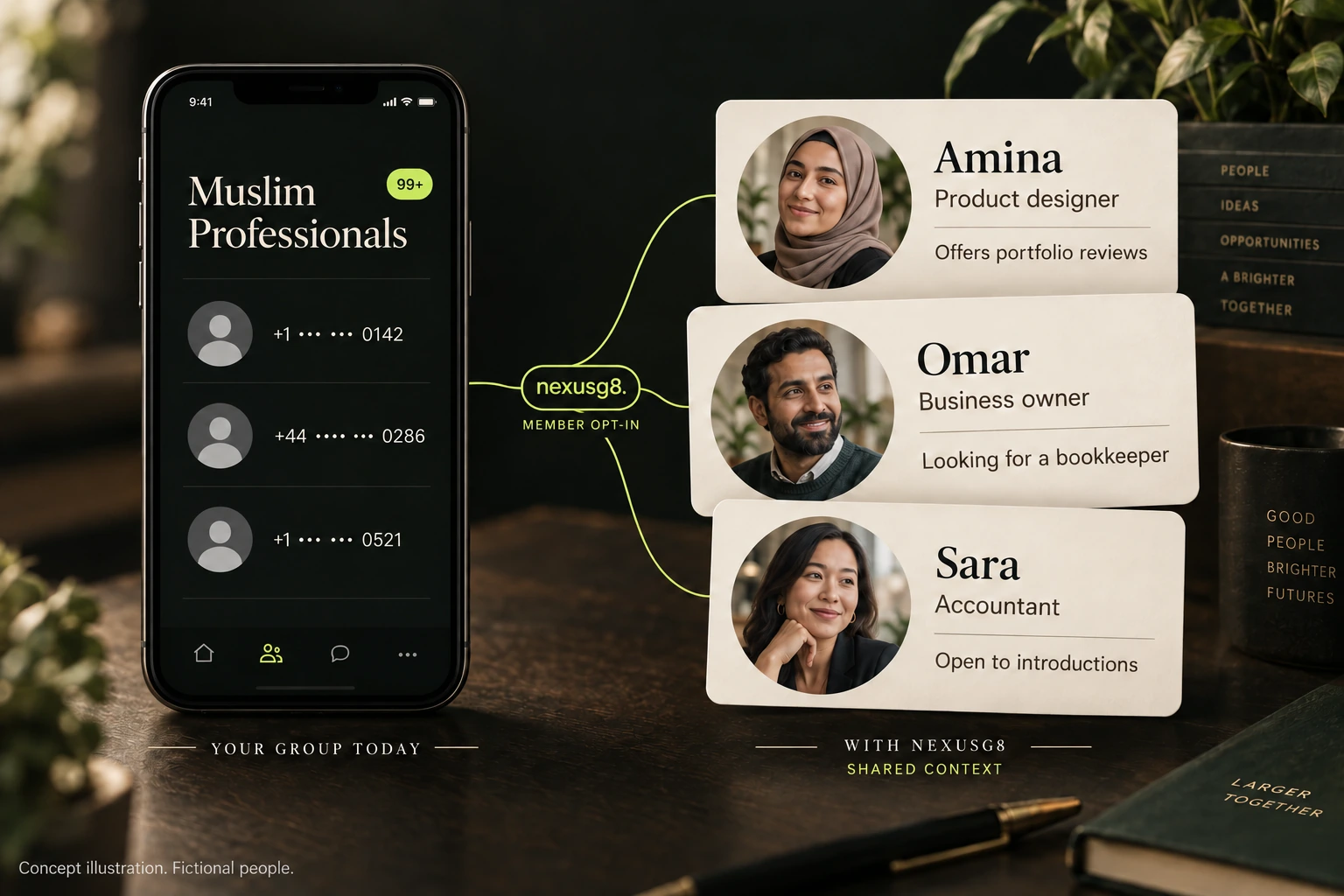
04 / THE PEOPLE BEHIND THE MESSAGES
WhatsApp groups and online communities bring people together around a shared purpose. But a phone number or display name tells you very little about the person behind it. As chats and channels multiply, skills, needs, and opportunities to help can stay buried in the noise.
Keep the conversation where it is. Invite members into a shared NexusG8 community, where they choose to make their skills, interests, and current needs visible. Give the right people a better chance to find one another.
The accountant a founder needs could already be in the same group. A shared profile makes that possibility easier to discover.
Illustrative interface and fictional profiles, not an actual WhatsApp screenshot. Members choose what to share; private chats and hidden identities are not imported or revealed.
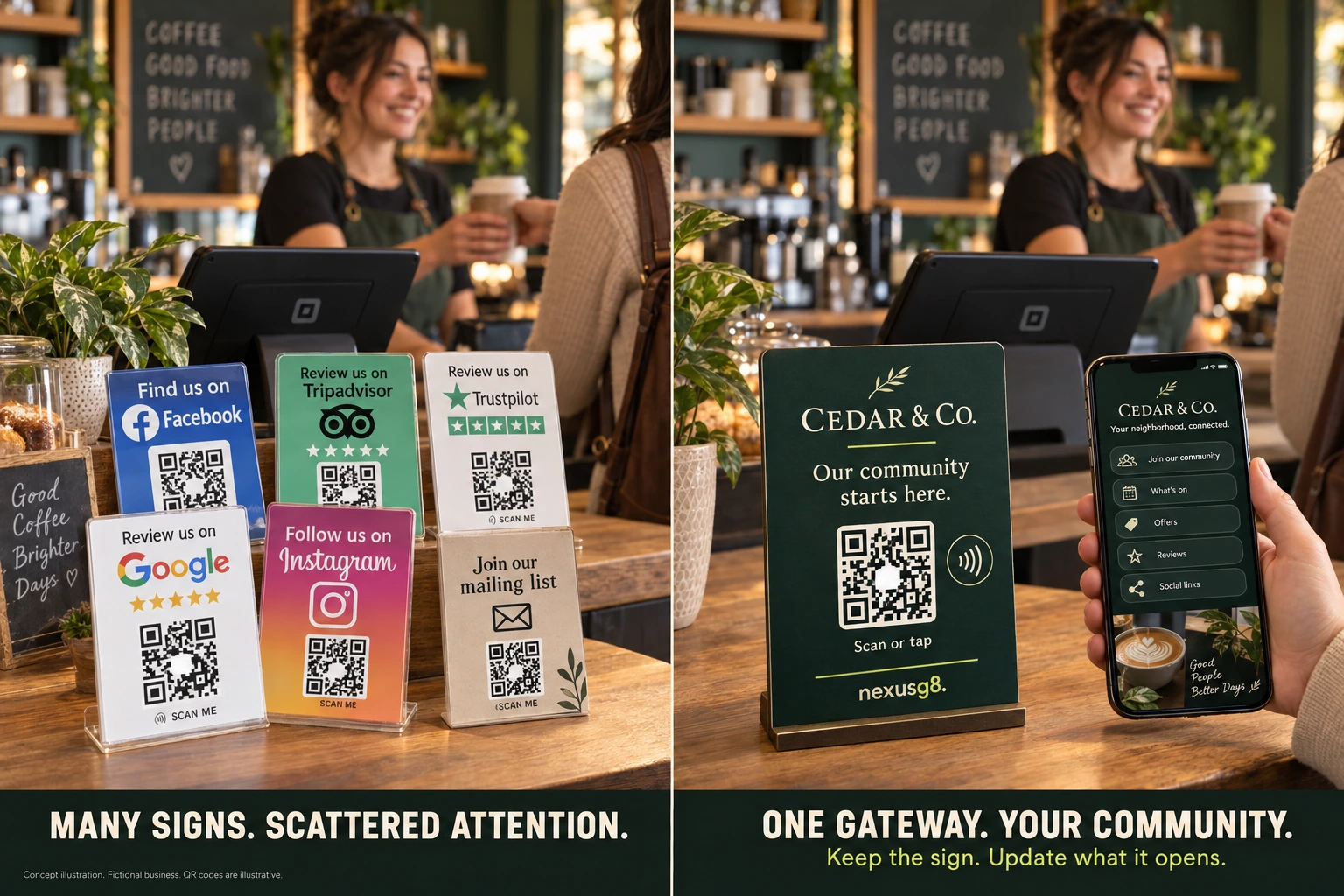
05 / A CONNECTION BEYOND THE COUNTER
Your team is busy serving. Meanwhile, separate signs ask customers to follow, review, subscribe, and stay in touch across different platforms. There is rarely one clear invitation to become part of your business’s community.
A NexusG8 QR or NFC gateway can give that invitation a home under your business’s name: a place to join the community and find updates, offers, review links, and social channels. Customers choose how to engage.
Keep the sign. Update what it opens.
Give customers one recognizable doorway as your news, links, and priorities change.
One shop or a franchise: apply the same idea location by location, with a familiar brand, a local community, and a named operator responsible for keeping it useful.
Bring your business to the betaIllustrative business and gateway concept. QR codes are not for use. Available features and any multi-location setup must be confirmed during onboarding; customer participation is voluntary.
All scenes are illustrations. These are possible use cases, not customer testimonials. Participation and outcomes depend on available features and member permissions.
Keep the group chat, the newsletter, the event page, and the tools people already use. A shared identity and permission layer gives relevant activity somewhere to connect.
Existing channels can link to NexusG8. This diagram does not imply automatic access to third-party data or completed integrations.
Member permissions across distinct community spaces.
Long-term direction: open interfaces that let independent developers build useful tools on the same foundation.
PIN means People, Intelligence, Networks. The supplied PIN-BLOCKS catalog describes 58 possible modules. A community can begin with a small, useful workflow and add capabilities as its needs grow.
Module designs are development specifications, not 58 shipped products. The open Bento schema and SDK remain part of the proposed blueprint.
Explore the module libraryThe next layer connects shared needs to practical economic value: relevant local commerce, accountable sponsorships, and voluntary group purchasing.
The advertising rails and automated purchasing system below are proposed expansion capabilities. Their value must be demonstrated in pilots.
Local-Collective Ad Revenue. A participating business could fund a clearly labeled offer for an opted-in local audience. A community hub receives contracted compensation for providing the channel.
Measure useful responses and merchant value. No purchase of private member lists.
Outer-Community Ad Revenue. Approved outside brands could sponsor relevant services or offers through participating communities, with visible terms and a community opt-out.
Measure incremental value. Religious identity is not an advertising audience to infer or sell.
Imagine restaurants pooling a comparable supply order. Change the assumptions. No supplier quote or actual saving is represented.
$75 per participating business
Assumptions: $30 logistics + $15 coordination per business per month. Equivalent quality and quantities. Larger groups do not automatically earn a discount; a supplier must agree to the terms.
A detected shared need creates a proposed buying group. People review the offer and opt in before any order. Buyer protection, supplier checks, logistics, and applicable law remain essential.
Read the purchasing and money-flow designA useful network depends on people having a meaningful say in how they participate. These are the principles that guide the model and the standards the blueprint asks it to meet.
Measure what helped: confirmed assistance, response time, net savings, and money actually paid.
Make power accountable: visible decisions, correction paths, independent review, and clear rights.
Members choose what they share and who can see it. Joining a community does not open every relationship, contact detail, or private request to everyone.
The proposed engine checks declared needs, offers, timing, capacity, and permissions. It avoids secret personality scores or inferred vulnerabilities.
Local leaders guide membership and community priorities. The blueprint adds documented appeals, conflicts-of-interest rules, and independent mission oversight.
Show how a benefit is calculated, what remains pending, and what has settled. Future trust and ownership claims require executed documents and evidence.
The civilizational ambition is durable capacity: communities able to organize their knowledge, negotiate together, and reinvest in their future. Expansion follows demonstrated usefulness, sustainable economics, and accountable governance.
Begin in Dallas–Fort Worth. Activate stewards, test useful routes, validate procurement savings, and reconcile the money.
Planning target: 100 anchor institutions.
Gate: repeat participation and verified value.
Expand where local density works. Develop continental routes, the open Bento SDK, and purchasing across metros.
Scale ambition: 5 million verified nodes.
Gate: retention, economics, and interoperability.
The “Great Retraction”: independent developers take on more front-end tools while NexusG8 concentrates on shared infrastructure.
Institutional goal: stronger trust governance.
Gate: independent clients and proven continuity.
Extend to suitable international community corridors, with lawful local operations and ethical cross-border commerce.
Long view: a resilient global utility.
Gate: local legitimacy and auditable benefit.
Dates are planning horizons. Numbers are conditional ambitions, not current adoption or forecasts. “Public utility” describes a service ambition, not a present legal designation.
Explore the complete 25-year plan
Muslim communities provide the first context for proving the idea: people, businesses, and institutions with reasons to help one another. The purpose is faith-informed service with practical benefit.
AMANAH / A TRUST TO HONOR
Treat people's information and relationships as a responsibility. Make it easier to contribute, seek help, and build honest livelihoods.
WAQF / AN ENDURING PURPOSE
The tradition of an endowment inspires the long-term vision: value that supports communities across generations. Formal trust arrangements remain work to adopt and implement.
CIaaS is designed to be useful across faiths, backgrounds, and kinds of community. Mecca Digital is the founding initiative; Mecca Digital LLC is identified on the public site as the company behind NexusG8. The model illustration is not a geographic map.
Explore the founding initiativeThis learning site brings the category, product direction, and institutional blueprint together. Each belongs at a different stage of proof.
NexusG8 publicly describes personal pages, community join requests and approval, directories, and broadcasts. Anyone can make a NexusG8 for free; joining a community is approved by its stewards. These are company-described capabilities, not an independent production audit.
Partner terms v1.3 specify the new program for 9 November 2026. The category page reports that payouts have not started. The calculator explains the published formula using hypothetical sales.
L-CAR, O-CAR, automated group purchasing, open Bento tooling, wider federation, and the module catalog describe designs to validate and implement.
5 million nodes, permanent trust governance, a 50% net-profit covenant, and international corridors are conditional goals. No claim of an existing endowment or guaranteed return is made.
Reviewed 10 October 2026 against the public category page, partner terms, the supplied site drafts and decks, and the institutional blueprint. The terms themselves govern eligibility and payments.
The blueprint's $200 million advertising pool is a founder planning assumption. It is not an audited loss, market-size finding, or proof that equivalent revenue can be captured. Current signups, audiences, and commitments are not presented as active users here.
Diagnosis, economics, deterministic routing, governance, and the year-by-year plan.
EXPLORE / THE DESIGN LIBRARY58 modules.Search the PIN-BLOCKS specifications by purpose, role, or development stage.
TAKE AWAY / THE FULL REPORTThe strategyDownload the report with the category integration chapter and economic distinctions.
A community uses shared infrastructure for identities, permissions, discovery, and coordination instead of building each system itself. NexusG8 operates the foundation and provides community spaces and tools. The service still needs a steward, willing members, and a useful purpose.
Imagine your whole school could say, “I can help with this” or “I need help with that.” A trusted organizer could help the right people meet. When useful paid activity earns a community share, that money could support the community. CIaaS is the shared system that helps this happen carefully.
A directory helps you find a name. The CIaaS model connects a current need to an available offer, checks permission, helps the introduction happen, and asks whether it helped. Shared accounting and governance make that workflow something a community can rely on.
You can keep existing channels and use links or QR codes to reach the shared community space. The long-term architecture invites outside developers to build specialized tools on open interfaces. It does not require NexusG8 to make every consumer app.
The blueprint's core uses information people deliberately provide: skills, needs, offers, time, and permission. Straightforward database rules can find relevant candidates. AI may assist with language under review, but the design does not require personality manipulation, inferred religion, or secret vulnerability scores.
Participation and proceeds sharing do not by themselves create equity, cooperative ownership, or an endowment. Current permissions follow the platform's policies. The blueprint proposes stronger member rights and independent mission governance that require formal adoption. Member-controlled sharing also does not authorize an organizer to export everyone's data.
People returning because useful help happened. Businesses showing net savings on comparable fulfilled orders. Organizers saving time. Communities receiving reconciled payments. The blueprint specifies how to measure those outcomes separately from clicks, signups, or estimated reach.
Start with an authorized steward and one concrete need: mentors, volunteers, or member discovery. Open your community’s Gate, agree who can see what, and help a small group complete a useful interaction. The first hundred community builders get a free year of Pro.

Start with your community. Bring a real need, a willing steward, and the people ready to help.
Your NexusG8 is free, and every community answers at its own door. No automatic enrollment or guaranteed outcome.